

The concept of 8 5/8 decimal often appears in everyday situations where measurements, calculations, or technical specifications are involved. While fractions like 8 5/8 are common in construction, manufacturing, and education, many systems require values to be expressed in decimal form. Converting fractions into decimals helps create consistency, accuracy, and ease of calculation. For students, professionals, and anyone working with measurements, understanding how 8 5/8 translates into a decimal builds confidence and reduces errors. This article explores the meaning of 8 5/8 decimal, how the conversion works, and why it matters in real-world applications.
What 8 5/8 Means as a Mixed Number
Before understanding the 8 5/8 decimal value, it is important to understand the structure of the number itself. The value 8 5/8 is a mixed number, meaning it combines a whole number with a fraction. In this case, the whole number is eight, and the fraction represents five parts out of eight equal parts. Mixed numbers are often used when measurements exceed a single unit but still require precision. This format is especially common in physical measurements such as length or height. Recognizing how the whole number and fractional components work together makes the conversion process more intuitive and helps prevent confusion when switching between number formats.
How to Convert 8 5/8 to a Decimal
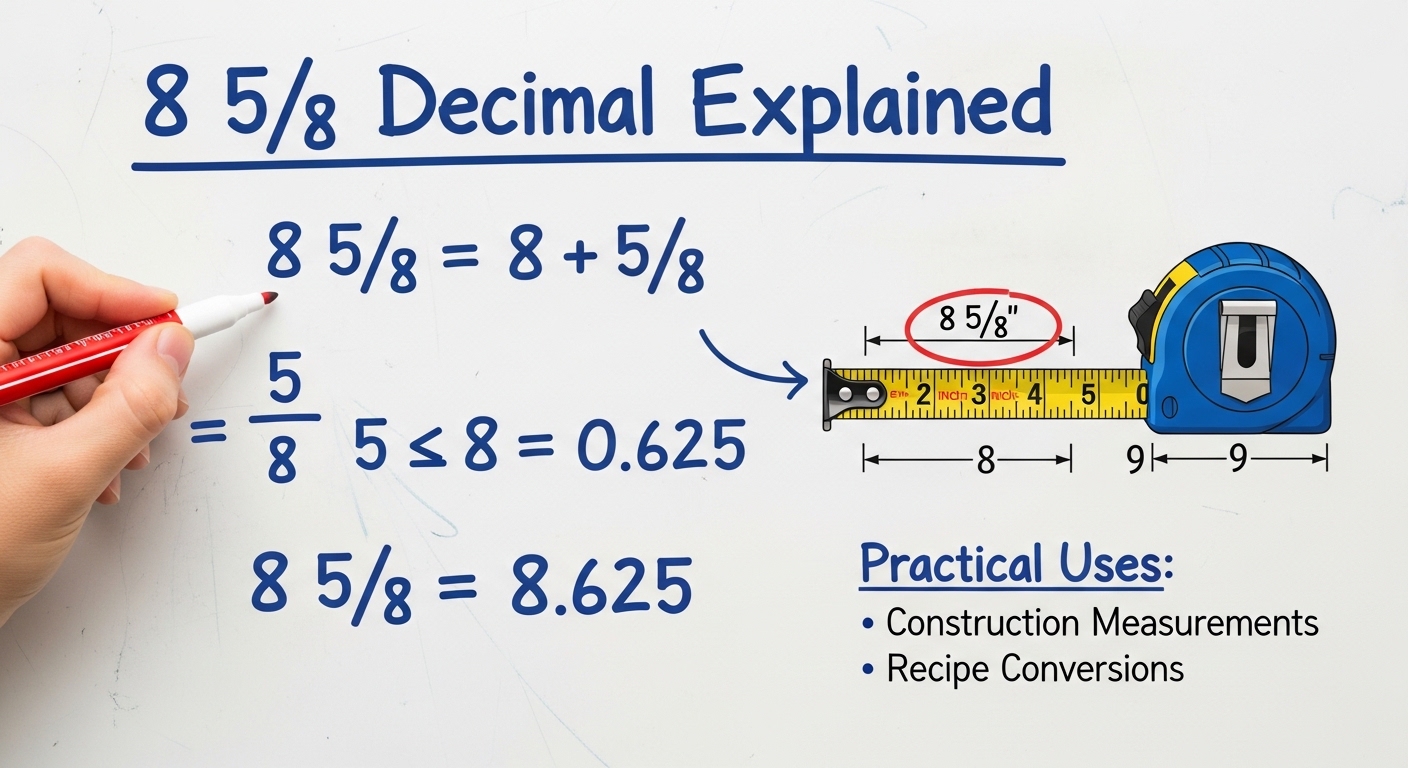
Converting 8 5/8 to a decimal involves changing the fractional part into decimal form and then adding it to the whole number. The fraction five eighths is converted by dividing five by eight. This calculation results in 0.625. When this decimal value is added to the whole number eight, the final result becomes 8.625. This value is the correct 8 5/8 decimal representation. Understanding this process is useful because it applies to all mixed number conversions. Once the fraction is expressed as a decimal, combining it with the whole number becomes straightforward and reliable for calculations.
Why the 8 5/8 Decimal Is Commonly Used
The 8 5/8 decimal value of 8.625 is frequently used in industries where precision is essential. Decimal numbers are easier to work with in digital systems, calculators, and spreadsheets. In engineering, design, and manufacturing, decimal values reduce the risk of misinterpretation and simplify calculations. The 8 5/8 decimal format allows for faster addition, subtraction, and comparison than fractional forms. In education, students are often taught to convert fractions into decimals to build number sense and problem-solving skills. This makes 8.625 a practical and widely accepted way to represent the same measurement.
Real-World Applications of 8.625
The decimal form of 8 5/8 appears frequently in real-world contexts. In construction and carpentry, measurements are often converted into decimals for planning and material estimation. In machining and technical drawings, decimal values like 8.625 ensure compatibility with tools and software that rely on metric or decimal-based systems. Even in finance or data analysis, understanding fractional conversions supports accurate reporting and calculations. Using the 8 5/8 decimal value allows professionals to communicate measurements clearly and avoid rounding errors. This consistency is essential when precision directly affects safety, cost, or performance outcomes.
Common Mistakes When Converting Fractions to Decimals
One common mistake when working with 8 5/8 decimal conversions is miscalculating the fractional division. Dividing five by eight incorrectly can lead to inaccurate results that affect subsequent calculations. Another error is forgetting to add the whole number after converting the fraction. Some people also confuse similar fractions, assuming five eighths equals 0.5 rather than the correct 0.625. These mistakes often occur due to rushed calculations or lack of familiarity with fractional values. Taking time to follow each step carefully ensures that the final decimal representation is accurate and dependable for practical use.
Conclusion
Understanding the 8 5/8 decimal value is an important skill for both academic learning and practical application. Converting 8 5/8 into 8.625 allows for clearer communication, easier calculations, and improved accuracy across various fields. By recognizing the structure of mixed numbers and applying a simple conversion process, anyone can confidently work with fractions and decimals. Mastering this concept supports better problem solving and ensures consistency when precise measurements matter most.